- Best for
- Deep drawers for cookware and tall items
- Approach
- Use height for upright storage, not hidden layers
- Start here
- Measure inside dimensions and drawer load guidance
Deep kitchen drawers can hold bulky items, but their height also makes it easy to build layers that hide the bottom. A useful drawer allows you to identify a category, lift one item and return it without unloading an unrelated stack. The solution begins with choosing contents that benefit from depth.
This guide covers deep drawers for cookware, food containers, tall pantry items and similar groups. Standard utensil drawers need a different plan, which is covered in our kitchen-drawer organization guide.
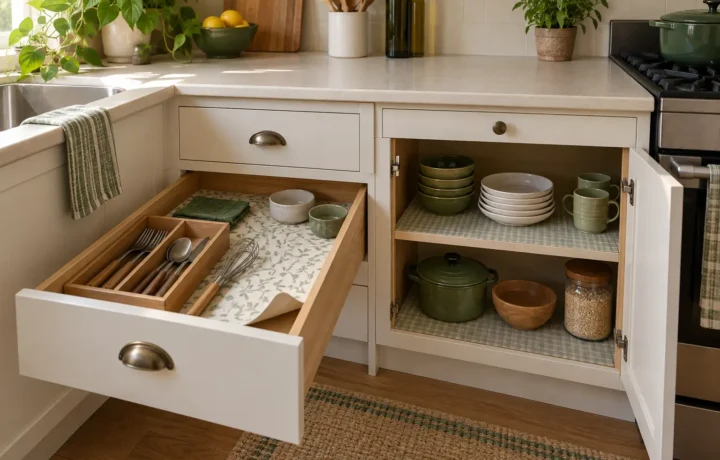
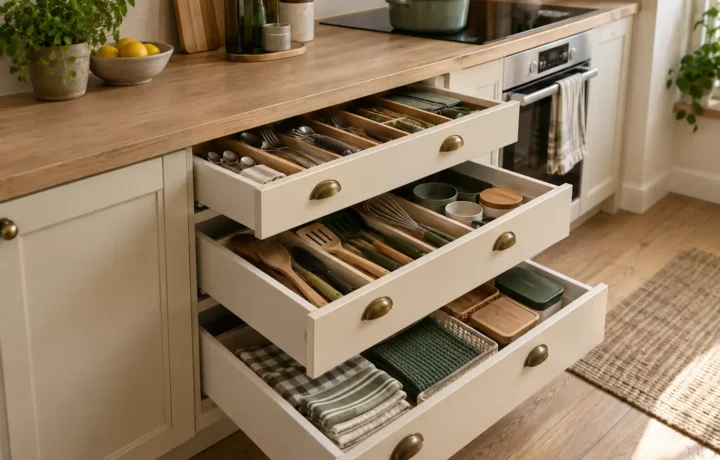
Editorial image note: the photographs in this guide are purpose-created illustrations of the organizing principles described. They are not presented as the author’s home, a client project or proof of a tested result.
In this guide
- 1. Measure the usable drawer, not the cabinet face
- 2. Give each deep drawer a compatible category
- 3. Edit duplicates and incompatible shapes
- 4. Use upright lanes for flat and tall pieces
- 5. Store food containers so every set is visible
- 6. Keep pantry items upright and contained
- 7. Add a shallow upper layer only for related tools
- 8. Fit dividers around the contents
- 9. Maintain visibility with a short reset
- Frequently asked questions
1. Measure the usable drawer, not the cabinet face
Open the drawer fully and measure its inside width, depth and height below any rail or counter obstruction. Note the space occupied by hardware and the clearance needed for tall items when the drawer closes. Check the manufacturer’s information or cabinet guidance for load and use limits instead of estimating how much weight the drawer can carry.
- Inside width between drawer sides
- Usable front-to-back depth
- Closing height below obstructions
- Clearance around slides and hardware
- Applicable load and care guidance
2. Give each deep drawer a compatible category
Cookware, lids, food containers, mixing bowls, tall packets or a limited pantry group may benefit from deep storage. Avoid combining very heavy pieces with fragile items or small tools that fall underneath. If the category includes both daily and rare items, keep the frequent group at the front and move the occasional pieces elsewhere.
Depth is not permission to stack indefinitely
When the bottom layer cannot be seen or removed without lifting several unrelated items, reduce the quantity or divide the category.
3. Edit duplicates and incompatible shapes
Empty one drawer only. Match lids, remove damaged pieces according to their care guidance and question duplicates that perform the same job. Odd handles, oversized lids and rarely used inserts may prevent an otherwise tidy group from fitting. Use the contained decluttering process so the rest of the kitchen stays functional.
4. Use upright lanes for flat and tall pieces
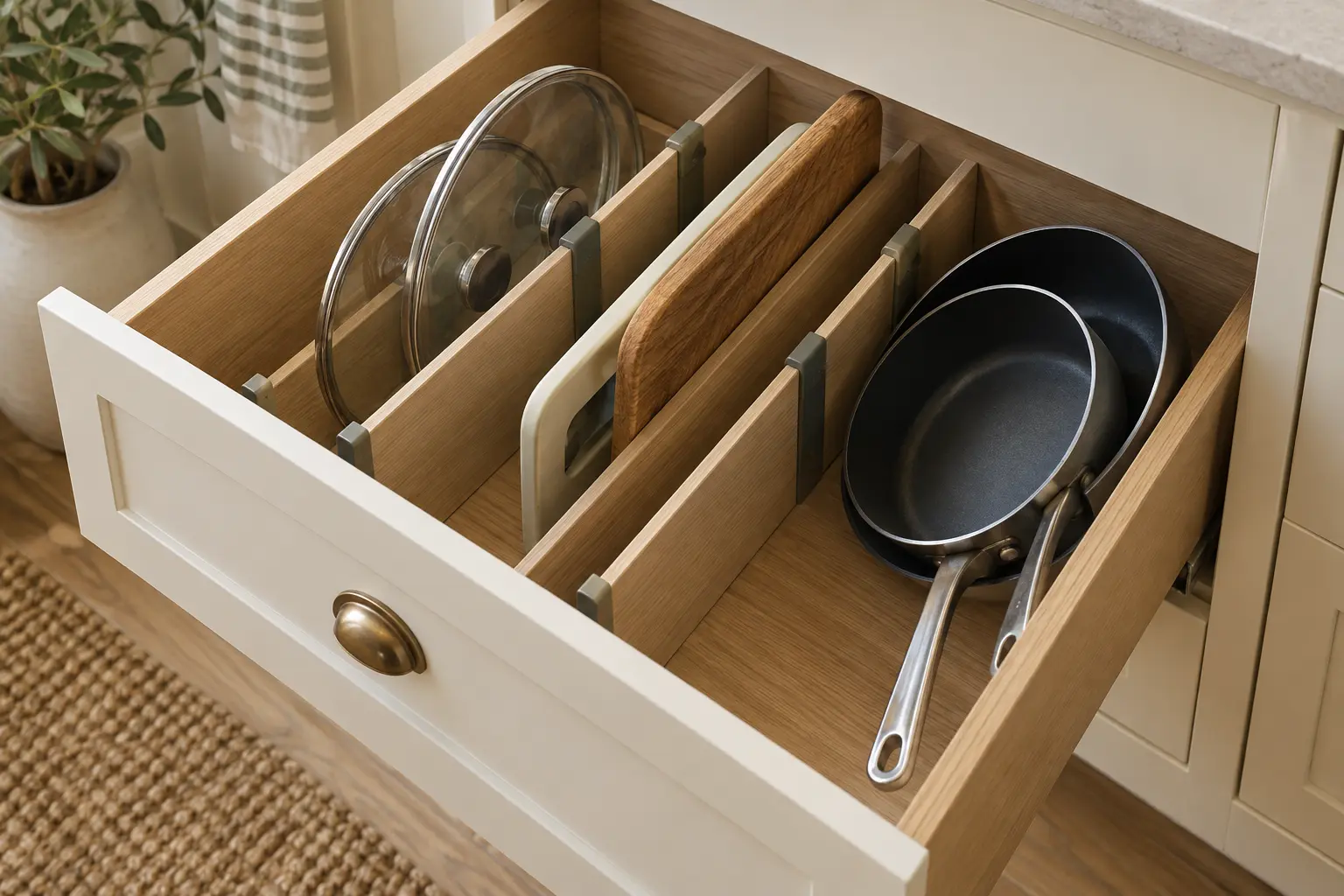
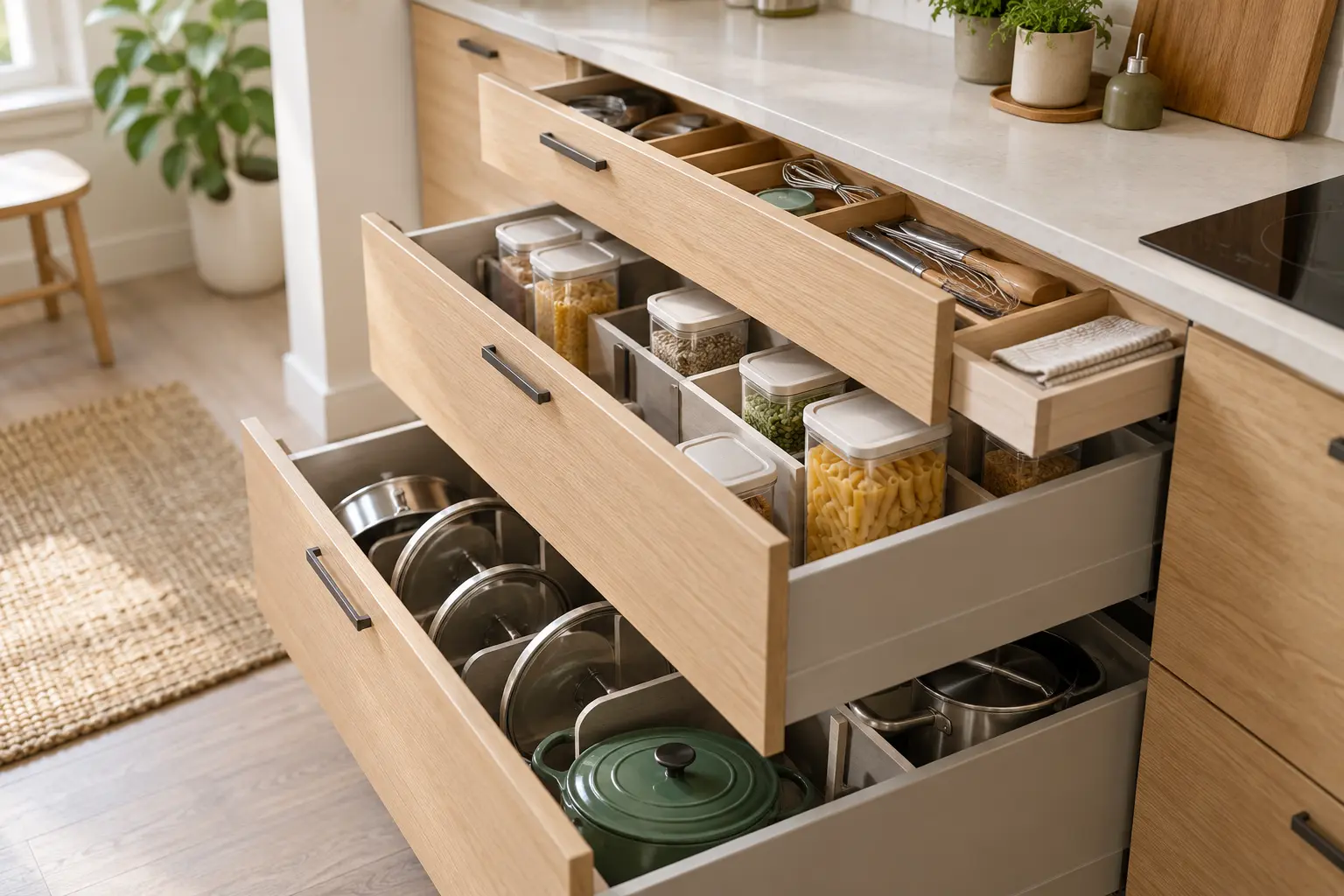
Vertical storage can work for lids, cutting boards and suitable pans when the pieces are stable and clear the top. Use fitted removable dividers or a rack designed for the contents. Place heavier pieces where they will not make the drawer tip or strain the hardware, and follow the drawer and organizer instructions.
Test one lane before filling every section. Open and close the drawer slowly, then remove the largest item without scraping the drawer front or catching the worktop.
5. Store food containers so every set is visible
Nest compatible bases in short runs and keep matching lids upright in a separate section. Do not create one tall tower that must be lifted each time. If the collection still overwhelms the drawer, use the food-storage-container guide to build a smaller compatible set.
6. Keep pantry items upright and contained
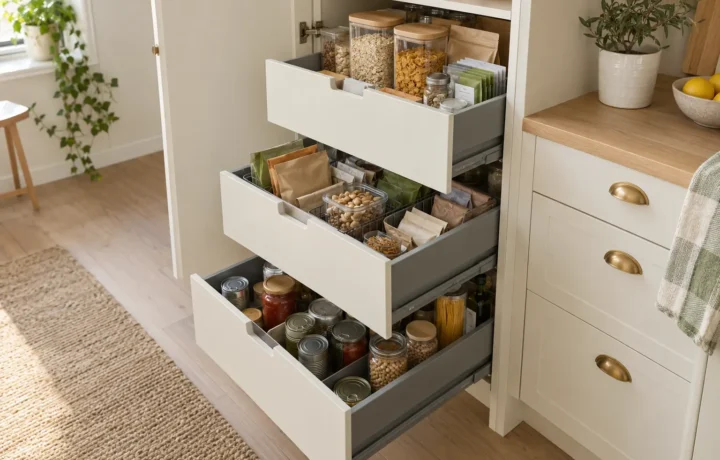
A deep drawer can hold packets, jars or sealed ingredients when the drawer is suitable and the food labels allow that storage. Use low-sided containers to keep categories from spreading, and label the top when fronts are not visible. Do not overfill around mechanisms or store items where heat, moisture or pests are a concern.
7. Add a shallow upper layer only for related tools
A removable tray can use some height for small items, but it should slide or lift without concealing the entire lower group. Keep its contents related to the drawer’s job—for example, measuring tools above baking supplies. Avoid a generic catchall tray that brings unrelated clutter back into the zone.
8. Fit dividers around the contents
Arrange the largest items first and use temporary cardboard guides to test lane widths. Then choose adjustable or removable dividers that fit the measured interior and remain stable when the drawer moves. A divider should support the category without pressing against delicate finishes or interfering with slides.
Allow extra width for fingers and for items that are not perfectly straight. A layout fitted to the millimetre can become unusable when a lid handle projects or a pan is returned at a slight angle. Working clearance matters more than filling every gap.
9. Maintain visibility with a short reset
Return each item upright or to its defined stack after washing. Once a week, remove anything that migrated into the drawer and check that dividers remain secure. When a new item enters, decide which lane it belongs in and whether an older duplicate should leave.
Watch for signs that the category has outgrown its zone: handles catch, a divider shifts, the drawer needs force to close or one item is repeatedly left on the counter. Correct the quantity or grouping before adding another layer.
- Keep one category per lane
- Limit stacks to what can be seen
- Leave hand space near the front
- Check that the drawer closes freely
- Review weight and stability after changes
Frequently asked questions
What should go in deep kitchen drawers?
Choose bulky or tall categories that benefit from depth, such as cookware, lids, compatible food containers or contained pantry groups, within the drawer's use and load guidance.
How do I stop things getting lost in a deep drawer?
Use upright lanes, low-sided category bins and no more layers than you can see and retrieve without unloading unrelated items.
Can pots and pans be stored vertically in a drawer?
They can when the drawer and dividers support their weight, the pieces remain stable and every item clears the top and hardware.
How do I organize a deep drawer without buying organizers?
Edit the category, arrange the largest items first and test zones with sturdy temporary boxes or cardboard guides before deciding whether a fitted organizer is needed.