- Best for
- Kitchens with an open gap above wall cabinets
- Approach
- Reserve the space for light, infrequent items
- Start here
- Measure clearance, reach and nearby services
Storage above kitchen cabinets can recover an overlooked gap, but it is a high, exposed and often dusty location. It should not become the default home for heavy appliances, fragile serving pieces or food you need every week. The useful version is a limited secondary zone with safe clearance and a realistic retrieval plan.
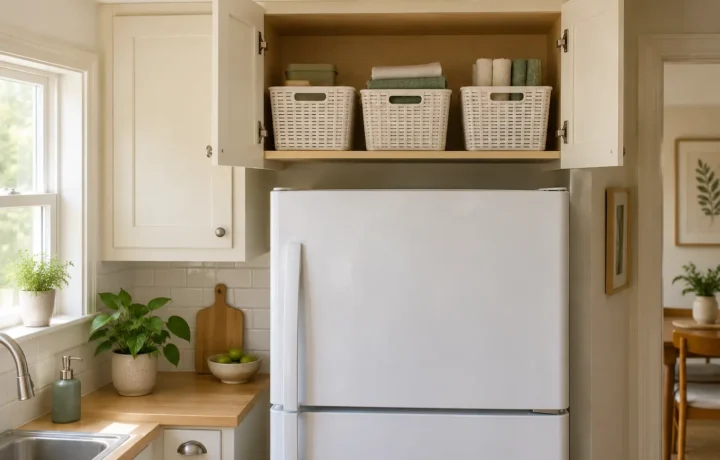
This guide focuses on the open run above wall cabinets. The cabinet over a refrigerator has different access and heat considerations, covered in our above-fridge cabinet guide. For the rest of the room, return to the small-kitchen organization plan.
Editorial image note: the photographs in this guide are purpose-created illustrations of the organizing principles described. They are not presented as the author’s home, a client project or proof of a tested result.
In this guide
- 1. Inspect the cabinet and ceiling zone
- 2. Map every required clearance
- 3. Choose only light, infrequent contents
- 4. Use stable, easy-to-grip containers
- 5. Plan the complete access route
- 6. Leave open space around the collection
- 7. Make cleaning possible
- 8. Review the zone each season
- Frequently asked questions
1. Inspect the cabinet and ceiling zone
Check that the cabinets appear sound and properly secured, and look for gaps, moisture, pest evidence, loose trim or damaged surfaces. Do not load or conceal a questionable installation. Ask the property owner or a qualified professional when the cabinet condition or permitted use is uncertain.
The cabinet top is not an unlimited shelf
Its safe use depends on the cabinet construction and installation. Keep the collection light and never assume a high surface can carry an appliance or dense archive.
2. Map every required clearance
Measure from the cabinet top to the ceiling and note vents, sprinklers, detectors, lighting, pipes and access panels. Keep all building services and manufacturer-required clearances completely unobstructed. Avoid areas affected by cooking heat, steam or grease.
Check door swing and crown moulding as well as the visible gap. Nothing should project where it can fall when a cabinet door closes or someone brushes the unit below.
3. Choose only light, infrequent contents
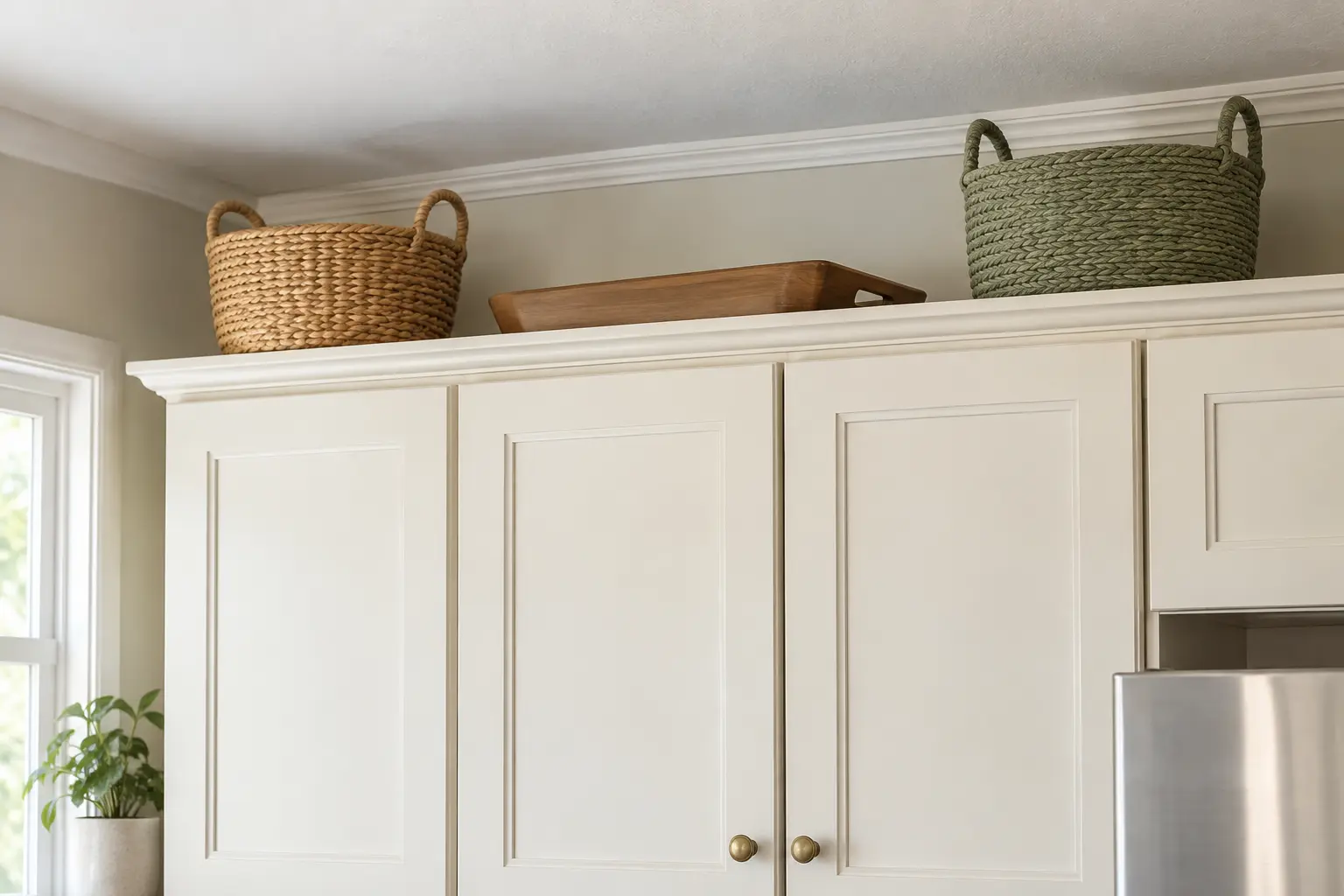
Good candidates are empty lightweight baskets, seasonal textiles, paper party supplies or other low-density items that tolerate the environment and are used rarely. Keep heavy appliances in supported lower storage; our small appliance storage guide explains why the lifting route matters.
- Avoid glass, ceramics and other breakables
- Avoid dense books, cans and appliances
- Avoid food exposed to heat, pests or uncertain temperatures
- Avoid anything needed during an emergency
- Avoid loose objects that can roll or slide
4. Use stable, easy-to-grip containers
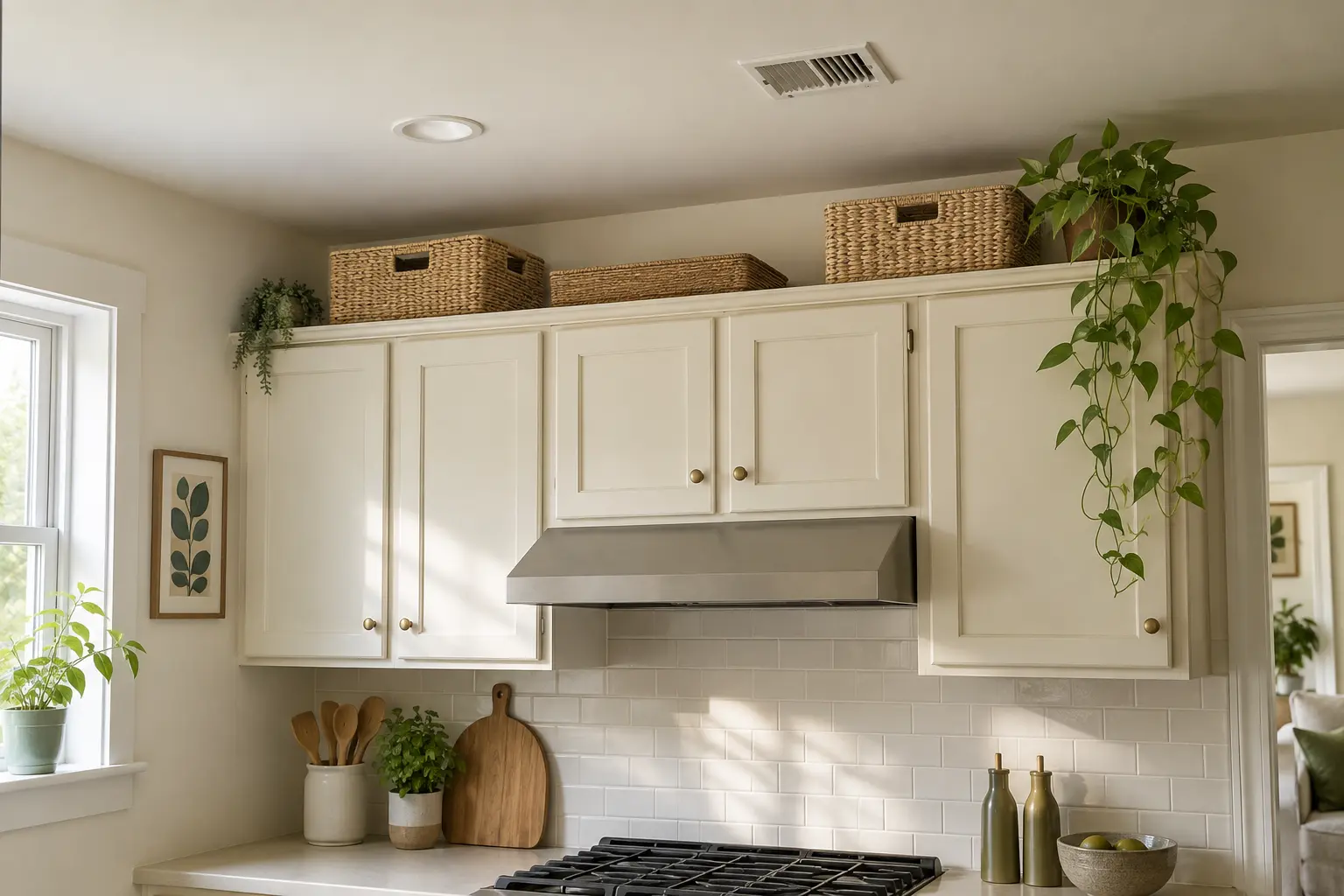
Select lightweight containers that fit fully on the available top and have secure handles or another safe grip. The container should remain manageable when filled; a large basket invites a load that is too heavy or awkward. Keep lids simple and do not stack containers unless the system is designed and stable for that arrangement.
Choose a wipeable exterior in a kitchen affected by airborne grease. A visual match can make the zone calmer, but function and weight matter more than identical styling.
5. Plan the complete access route
Use a suitable household step stool on a level clear floor and follow its instructions. Do not climb on counters, chairs or cabinet shelves. Confirm that the container can be gripped with both hands without overreaching and that another person can use the route safely when necessary.
If retrieval requires moving several obstacles, twisting under a ceiling or handling a load above comfortable reach, the item belongs somewhere else. High storage is optional capacity, not a reason to accept an unsafe routine.
6. Leave open space around the collection
Treat each cabinet run as one composition instead of filling every centimetre. Two or three restrained containers with visible space are easier to dust, count and retrieve than a continuous line of unrelated objects. Keep the tallest items away from sloped ceilings and services.
Use one category per container and add a discreet front-facing label only when the contents are not obvious. Keep a short inventory at eye level if you otherwise forget what is overhead.
7. Make cleaning possible
Schedule a periodic removal and wipe-down appropriate to the room. Let surfaces and containers dry before returning them. If grease or dust accumulates faster than expected, reduce the collection or abandon the zone rather than sealing dirt beneath decorative objects.
Inspect for cabinet movement, moisture and pest activity during each clean. Stop using the space and report concerns when the structure or environment changes.
8. Review the zone each season
Ask whether each item was used, retrieved safely and returned easily. Donate, relocate or responsibly dispose of things stored only because the gap existed. Keep the zone lighter than its maximum visual capacity.
If the contents become frequent, move them lower. If they become forgotten, decide whether they deserve storage at all. The best above-cabinet zone stays intentionally small.
Frequently asked questions
Is it safe to store things above kitchen cabinets?
It can be appropriate for a small number of lightweight items when cabinets are sound, services and clearances stay open and retrieval uses a proper step stool without overreaching.
What should I store above kitchen cabinets?
Choose light, infrequently used and non-fragile items in manageable containers. Keep heavy appliances, glass, emergency items and temperature-sensitive food elsewhere.
How do I make above-cabinet storage look less cluttered?
Use fewer containers, limit the material palette, keep one category per container and leave visible space rather than filling the whole run.
How do I keep the top of kitchen cabinets clean?
Use easy-to-lift wipeable containers, remove the complete collection periodically and clean and dry both the cabinet top and containers before replacing them.