- Best for
- Pull-out pantry drawers and deep food drawers
- Approach
- Design for the view from above
- Start here
- Measure internal size and open clearance
Kitchen pantry drawers can make a compact food cupboard easier to reach, but only when the contents are visible from above. Tall packages can block the drawer above, small packets can slide under larger ones and an overfilled drawer can become heavy or difficult to close. The layout has to respect the drawer before it can organize the food.
This guide focuses on food stored in pull-out pantry drawers. For a complete shelf-and-zone plan, see how to organize a small kitchen pantry. For cookware and utensils, use our separate deep kitchen drawer guide.
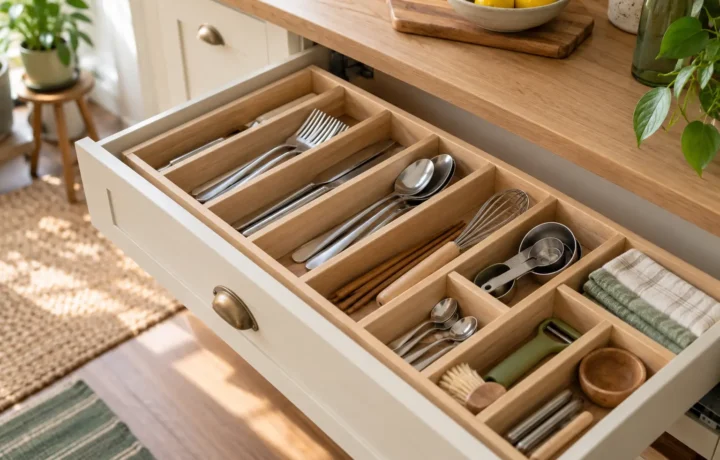
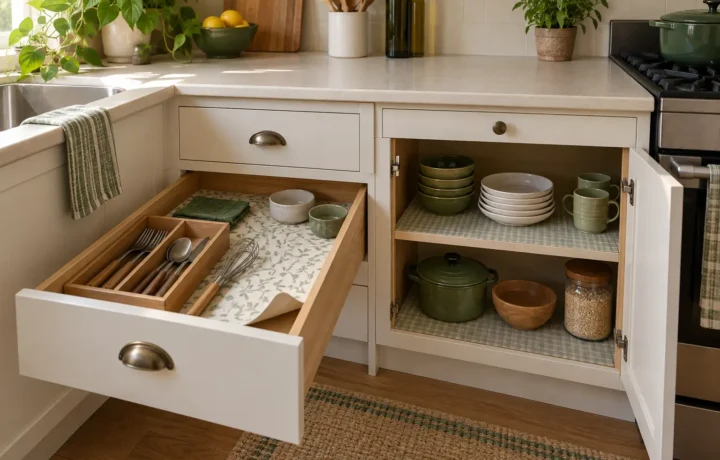
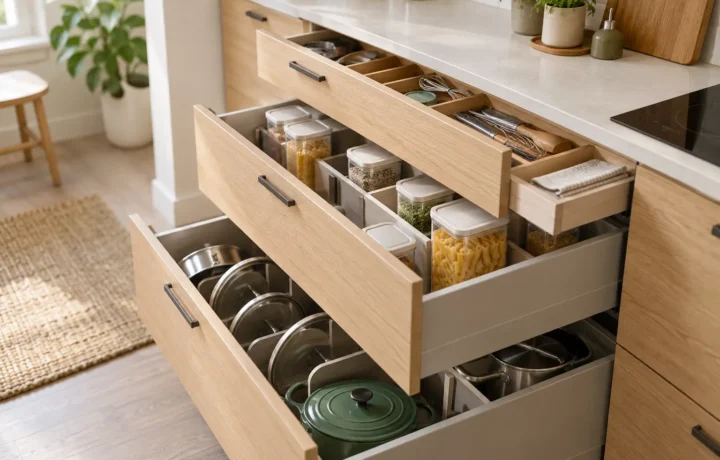
Editorial image note: the photographs in this guide are purpose-created illustrations of the organizing principles described. They are not presented as the author’s home, a client project or proof of a tested result.
In this guide
- 1. Measure the drawer in its working position
- 2. Sort by package behavior as well as food type
- 3. Design for the top view
- 4. Use low dividers that match the category
- 5. Distribute weight and protect the drawer
- 6. Give each category a visible capacity
- 7. Label where the eye actually looks
- 8. Restock from the back and reset from the front
- Frequently asked questions
1. Measure the drawer in its working position
Measure the internal width, depth and usable height, then open the drawer fully and check what the drawer above, counter edge or cabinet frame allows. Record the narrowest point around slide hardware. If the manufacturer provides a load rating, follow it. Without reliable load information, keep heavy groups modest and watch for sagging, sticking or loose hardware.
Test height with the drawer above closed
A package can fit inside an open drawer and still catch the rail or drawer above. Test the tallest item through the complete opening and closing motion before committing the layout.
2. Sort by package behavior as well as food type
Separate upright packets, round cans, glass jars, small snack pieces and bulky bags. Two foods used for the same meal may need different support inside the drawer. The aim is to keep each package stable and identifiable while preserving the routine-based pantry zones.
- Upright packets that need a narrow lane
- Cans or jars that need a stable base
- Small pieces that need a shallow removable bin
- Bulky bags that require a wider zone
- Backstock that must not hide the active item
3. Design for the top view
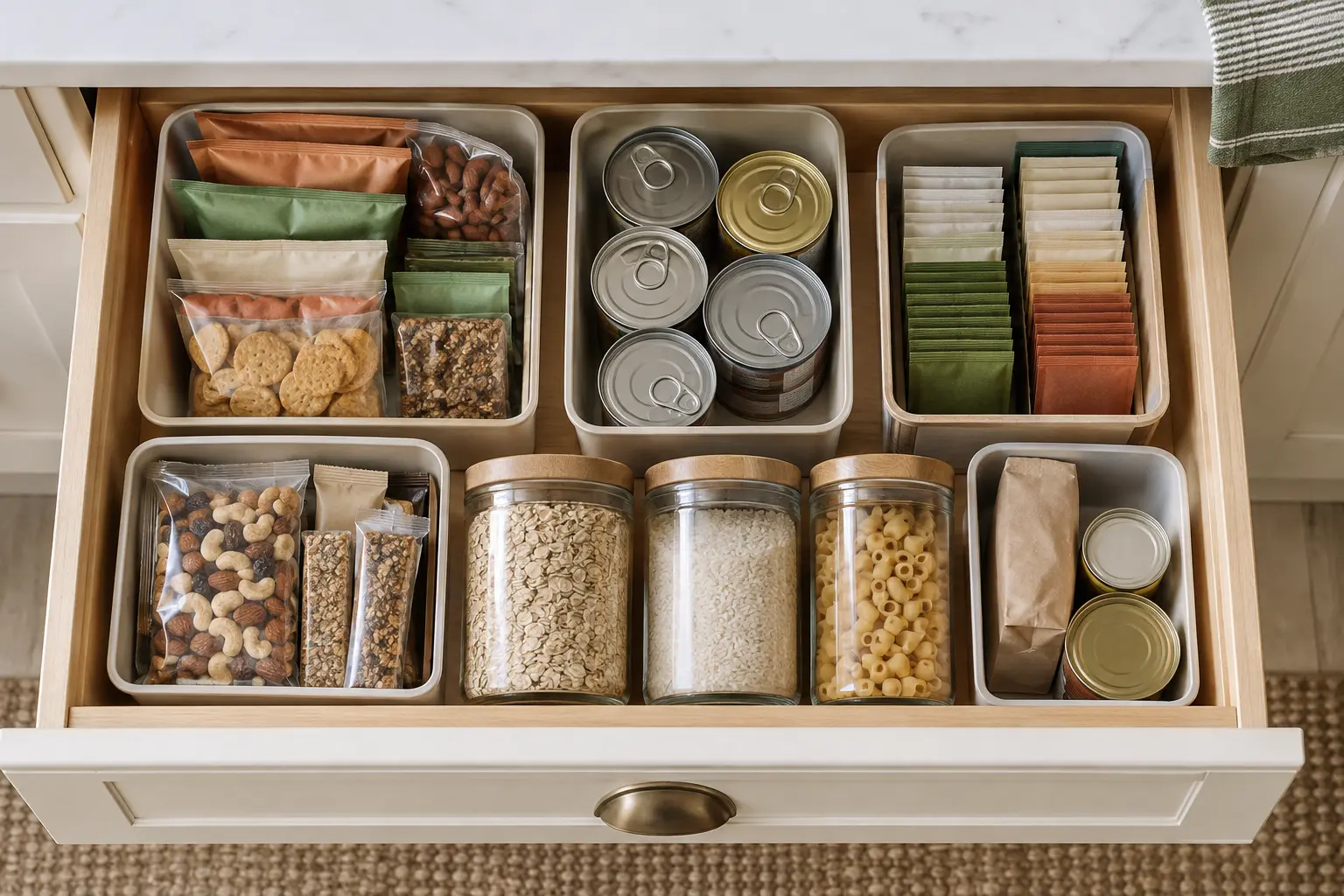
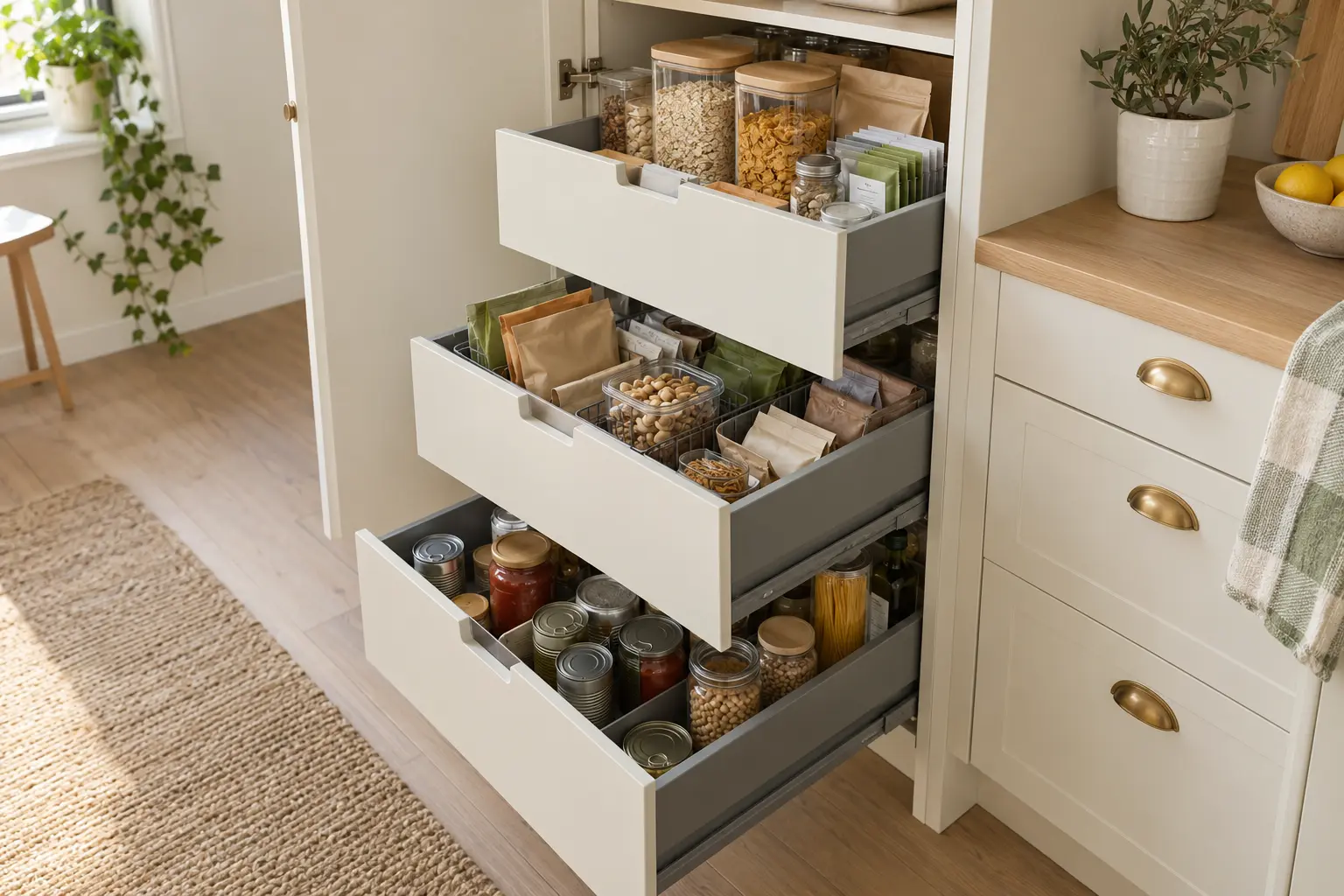
Lay the category out so the identity or label can be seen from above. Stand packets upright when the drawer height and package allow, place can tops where they remain visible and avoid stacking unlike items. When two layers are unavoidable, keep the second layer to identical backstock directly under or behind the active item.
Move tall packages to a shelf when they block the overview. The drawer should not become a substitute for a pantry shelf if its geometry makes the food harder to identify.
4. Use low dividers that match the category
A divider should stop sideways movement without consuming the opening or hiding labels. Test small boxes or temporary cardboard lanes before buying a system. Check that each piece remains below the closing clearance, does not interfere with hardware and can be removed for cleaning.
Choose a narrow lane for flexible packets, a shallow bin for small items and a broad open zone for bulky bags. Do not force every category into equal rectangles; the food quantities and package shapes are not equal.
5. Distribute weight and protect the drawer
Place heavier items near supported areas and spread them rather than concentrating every jar in one corner. Do not overload the drawer to gain one more row. If it stops closing smoothly, makes unusual noise or the base flexes, reduce the contents and inspect the hardware.
Keep leaking or breakable products in stable positions and follow their storage instructions. A washable shallow tray can contain minor crumbs or drips when it fits without blocking the slides, but it does not replace checking damaged packaging.
6. Give each category a visible capacity
Set a boundary that reflects how much the household uses between shops. One lane of pasta or one shallow bin of snacks is clearer than an undefined drawer that expands with every purchase. When the boundary is full, use the existing supply before adding more unless there is a planned need.
Leave a little open area for the temporary increase after grocery day. A drawer packed perfectly to its edge has no place for an unexpected package and will fail during the first restock.
7. Label where the eye actually looks
Use top-facing labels for decanted containers or upright packets when side labels disappear below the drawer wall. Preserve product identity, relevant dates and preparation or safety information. For bins, a simple label on the upper edge can show where the category returns without covering the contents.
Temporary labels are useful during the first two restocks. If the same item repeatedly ends up in a neighbouring lane, adjust the boundary or wording instead of treating the household as the problem.
8. Restock from the back and reset from the front
Before adding groceries, remove obvious empties and bring forward older suitable stock. Add identical newer items behind the active item when package dates and guidance support that order. Return loose pieces to their bin and make sure nothing protrudes into the closing path.
- Clear empty packaging
- Check dates and product condition
- Bring the active item forward
- Place matching backstock behind it
- Close the drawer slowly and confirm full travel
Frequently asked questions
What should I store in kitchen pantry drawers?
Store food that remains visible and stable from above, such as upright packets, cans, jars and small items contained in shallow bins. Move packages that block the closing clearance or overview.
How do I organize deep pantry drawers?
Create top-view lanes with low dividers, limit hidden layers and give each category a visible capacity. Keep any second layer to identical backstock rather than unrelated food.
Can I use regular bins in pantry drawers?
Yes when the bin fits the internal dimensions, stays below the closing clearance, does not interfere with slides and can be lifted safely when full.
How do I stop pantry packets from falling over?
Stand them in a narrow lane or shallow removable bin sized to the packet group. Test the width first so the support is firm without crushing packages.