- Best for
- Blind and deep corner cabinets
- Approach
- Plan around access, not empty volume
- Start here
- Identify the cabinet type and measure the opening
A corner kitchen cabinet often looks generous while functioning like a much smaller space. The opening is narrow, the back is deep and anything placed beyond easy reach can disappear. Good organization starts with the route an item must travel through the door, not with the cabinet’s total internal volume.
This guide explains how to organize a corner kitchen cabinet using removable zones and realistic access limits. It supports the wider small-kitchen organization plan while focusing only on awkward upper, lower and blind-corner storage.
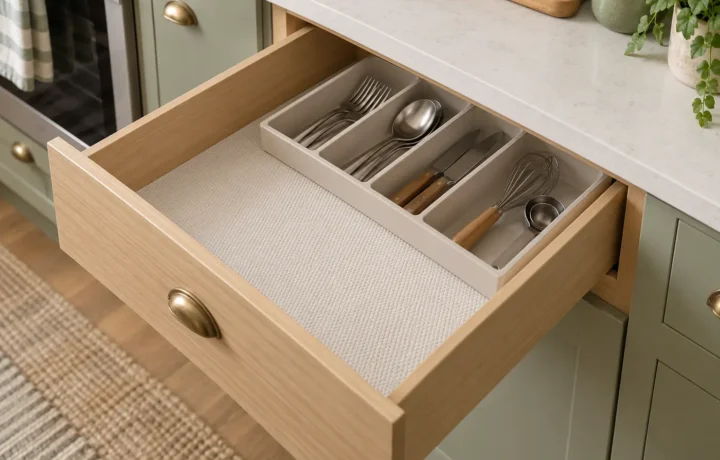
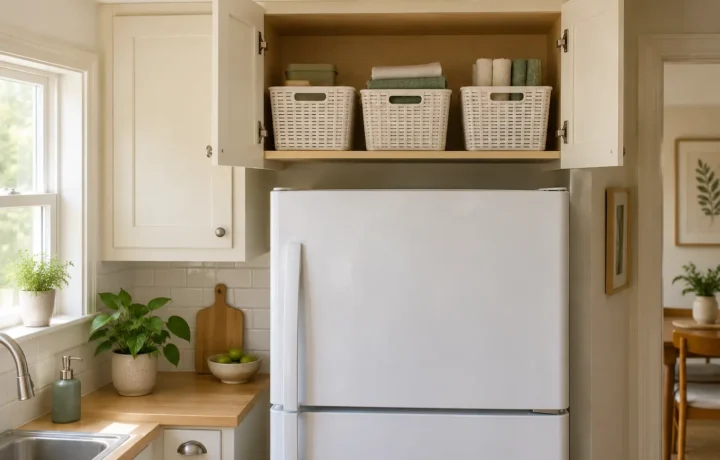
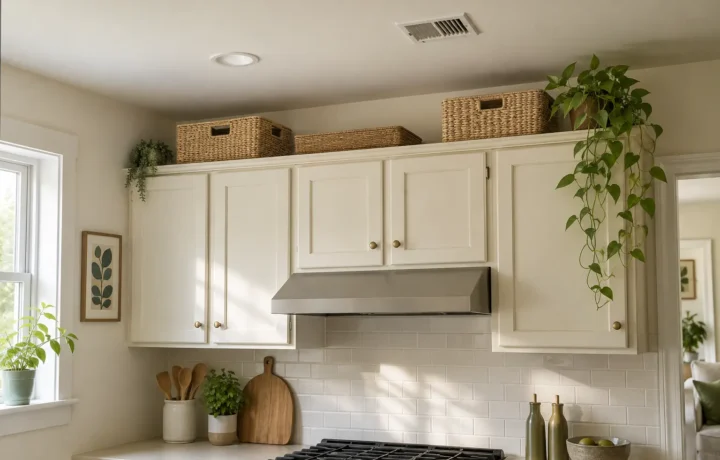
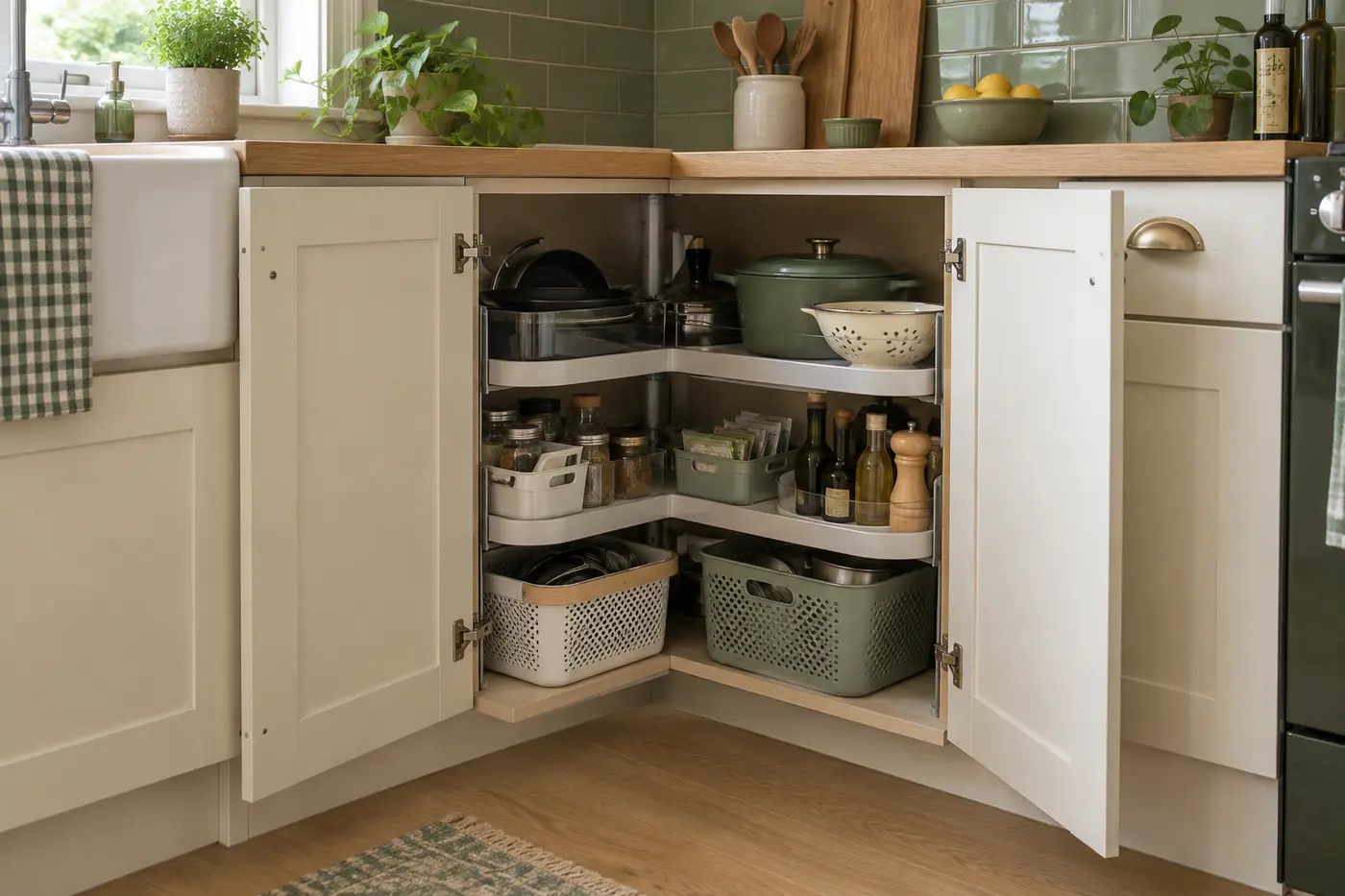
Editorial image note: the photographs in this guide are purpose-created illustrations of the organizing principles described. They are not presented as the author’s home, a client project or proof of a tested result.
In this guide
- 1. Identify the corner cabinet you have
- 2. Empty the cabinet and measure the access path
- 3. Remove items that do not deserve difficult storage
- 4. Choose contents that suit the cabinet
- 5. Divide the cabinet into front and back zones
- 6. Keep upper corner cabinets light and visible
- 7. Make lower blind corners retrievable
- 8. Label hidden groups and record backstock
- 9. Test retrieval before filling the cabinet
- Frequently asked questions
1. Identify the corner cabinet you have
Open every door and look at the cabinet from the front and side. An upper diagonal cabinet usually offers a broad interior behind one angled door. A blind corner has an accessible section beside a deeper area that extends behind another cabinet. A lower corner may include fixed shelves, a rotating fitting or a pull-out mechanism.
Do not assume a storage solution shown for one cabinet type will fit another. Door hinges, face frames, plumbing, shelf supports and the angle of the opening all change what can move in and out.
2. Empty the cabinet and measure the access path
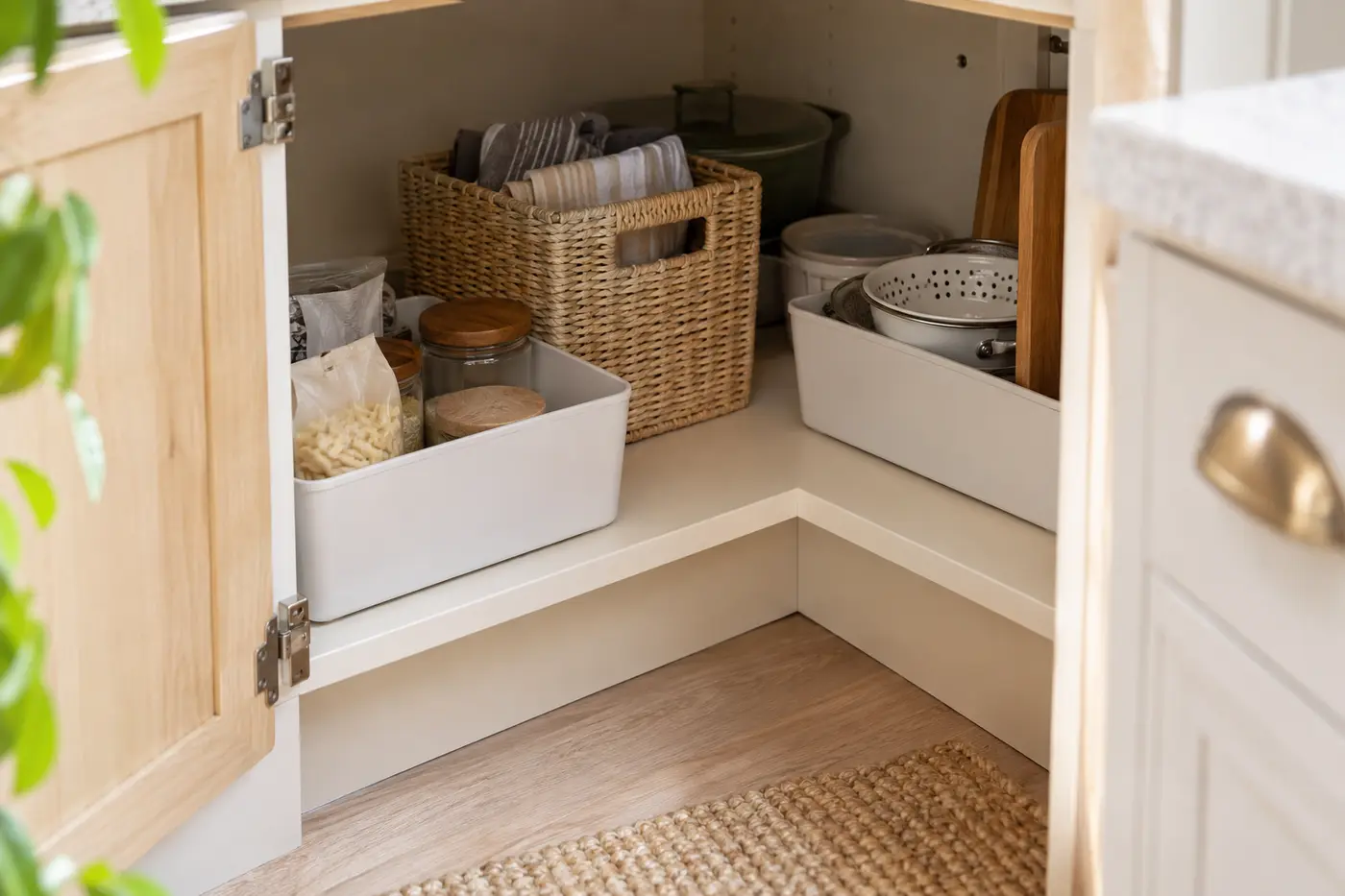
Remove the contents and clean the cabinet using a method suitable for its finish. Measure the opening width and height first. Then record the usable depth, shelf width and clearance around hinges or a face frame. Test the route with a cardboard box before buying a rigid organizer.
- Door-opening width and height
- Reachable depth from the front
- Clearance around hinges and shelf supports
- Space needed to lift or rotate a container
- Weight and installation limits supplied by the cabinet or organizer manufacturer
3. Remove items that do not deserve difficult storage
A deep corner should not become a hiding place for duplicates, damaged cookware or supplies with no assigned use. Apply the contained kitchen-decluttering method before selecting organizers. Keep the best version of a duplicate and move unrelated items to the zone where they are used.
Use access as the limit
If an item cannot be removed without unloading several unrelated things, it does not have a practical home yet. Reduce the quantity, change the grouping or move it elsewhere.
4. Choose contents that suit the cabinet
Corner cabinets work best for medium-frequency categories that can be grouped. Lightweight mixing bowls, small appliances used together, serving pieces or sealed backstock may fit. Daily essentials usually deserve a simpler front-facing cabinet or drawer. Very heavy, fragile or hazardous items should not be placed where retrieval is unstable or visibility is poor.
Keep a category together rather than scattering single items through the depth. One breakfast-appliance group is easier to retrieve than a toaster behind unrelated vases and baking tools.
5. Divide the cabinet into front and back zones
Treat the first reachable section as active storage. Put moderately used items there in shallow trays or low-sided bins. Reserve the deeper section for one clearly defined, infrequent category. A removable bin with handles can turn the hidden area into a single retrievable unit.
Avoid making several loose rows. When the front row must be removed, it should come out in one or two movements rather than piece by piece.
6. Keep upper corner cabinets light and visible
Use the lower shelf of an upper cabinet for the items you reach for most. Place lighter and less frequent groups higher up. A turntable may help small bottles or jars when it fits the opening and every item remains visible, but it can waste space when the cabinet shape or door clearance is wrong.
Use shelf risers only when the upper level remains stable and easy to see. Do not stack objects above a safe, comfortable lifting height.
7. Make lower blind corners retrievable
In a lower blind corner, use sturdy bins or trays that can slide through the opening without catching. Keep the front section clear enough to remove the back container. If the cabinet has a built-in mechanism, follow its operating and weight instructions and keep the movement path free.
Do not force a generic pull-out into a cabinet it was not designed for. Permanent hardware must suit the cabinet construction and may require landlord approval or qualified installation.
8. Label hidden groups and record backstock
Label the front edge of a bin with the category, not every item. If sealed backstock lives in the deep section, keep a short note on the inside of the door or in a shopping-list app. The reminder prevents buying another item simply because the first one is out of sight.
9. Test retrieval before filling the cabinet
Load one category and remove it twice. Check whether the door opens fully, the bin clears the frame and the items stay stable. Add the next category only after the first works. Leave some open space for your hands and for the container to turn.
- Monthly: return items to their assigned bin or tray
- Seasonally: check the deep section for forgotten duplicates
- When the door catches: reduce the container width or fill level
- When an item is never used: move or release it rather than improving its hidden storage
Frequently asked questions
What should be stored in a corner kitchen cabinet?
Store grouped, moderately used items that can be retrieved safely, such as lightweight bowls, serving pieces or one small-appliance category. Daily essentials usually need easier access.
How do I organize a deep blind corner cabinet?
Create a front active zone and place the deep category in one removable handled bin. Keep enough clearance to pull the back container through the opening.
Are turntables good for corner cabinets?
They can help when the diameter, height and door clearance fit the cabinet and the items remain stable. Measure the access path before choosing one.
How do I stop things from getting lost in a corner cabinet?
Limit each section to one category, use retrievable containers and keep a visible label or backstock note for anything stored beyond the front zone.