- Best for
- Small counters and daily beverage routines
- Approach
- Contain one routine without losing prep space
- Start here
- Start with appliance guidance and a measured footprint
A coffee station can simplify a daily routine, but in a small kitchen it can also take over the only useful work surface. The goal is not to display every mug, flavour and appliance. It is to keep one beverage routine together, meet the equipment requirements and leave enough clear counter for the kitchen’s other work.
This guide plans a compact coffee station on a kitchen counter, with alternatives when the counter is too limited. For deciding which machines deserve space at all, start with our small-appliance storage guide. The broader room layout is in the small-kitchen organization guide.
Editorial image note: the photographs in this guide are purpose-created illustrations of the organizing principles described. They are not presented as the author’s home, a client project or proof of a tested result.
In this guide
- 1. Define one beverage routine
- 2. Protect the main preparation area
- 3. Contain the active set on a shallow tray
- 4. Keep a practical number of mugs nearby
- 5. Store small supplies in one drawer or bin
- 6. Plan the water, waste and cleaning path
- 7. Use a cabinet or cart when the counter is too small
- 8. Reset the station after the final drink
- Frequently asked questions
1. Define one beverage routine
List the items used for the drink made most often: perhaps the machine or kettle, coffee or tea, filters, one measuring tool and the mugs used by the household. Keep occasional syrups, serving pieces and backstock out of the daily footprint. A station earns its space by shortening a repeated sequence, not by displaying the entire category.
Start with the equipment instructions
Follow the manufacturer’s requirements for ventilation, water, heat, electrical connection, filling, opening and cleaning. The visual layout must adapt to those requirements, not the other way around.
2. Protect the main preparation area
Identify the counter section needed for chopping, mixing or serving and keep it clear. Measure the remaining candidate zone, including the appliance with lids, reservoirs or baskets fully open. Check access to the outlet without using a cord route that crosses water, heat, a walkway or a moving door.
If the station leaves no comfortable place to prepare food, reduce the daily set or choose a different location. A narrow routine is more useful than a beautiful station that makes every meal harder.
3. Contain the active set on a shallow tray
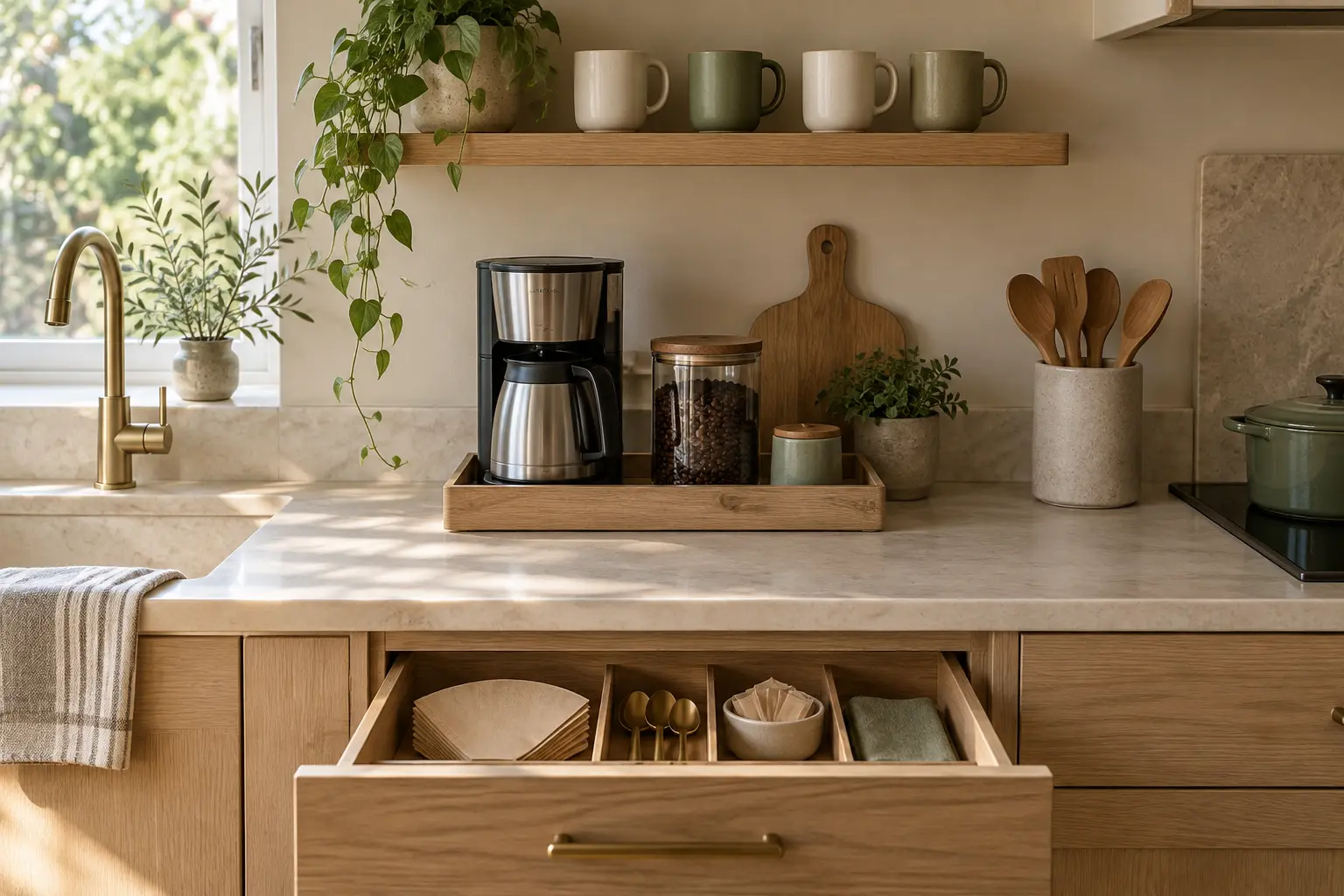
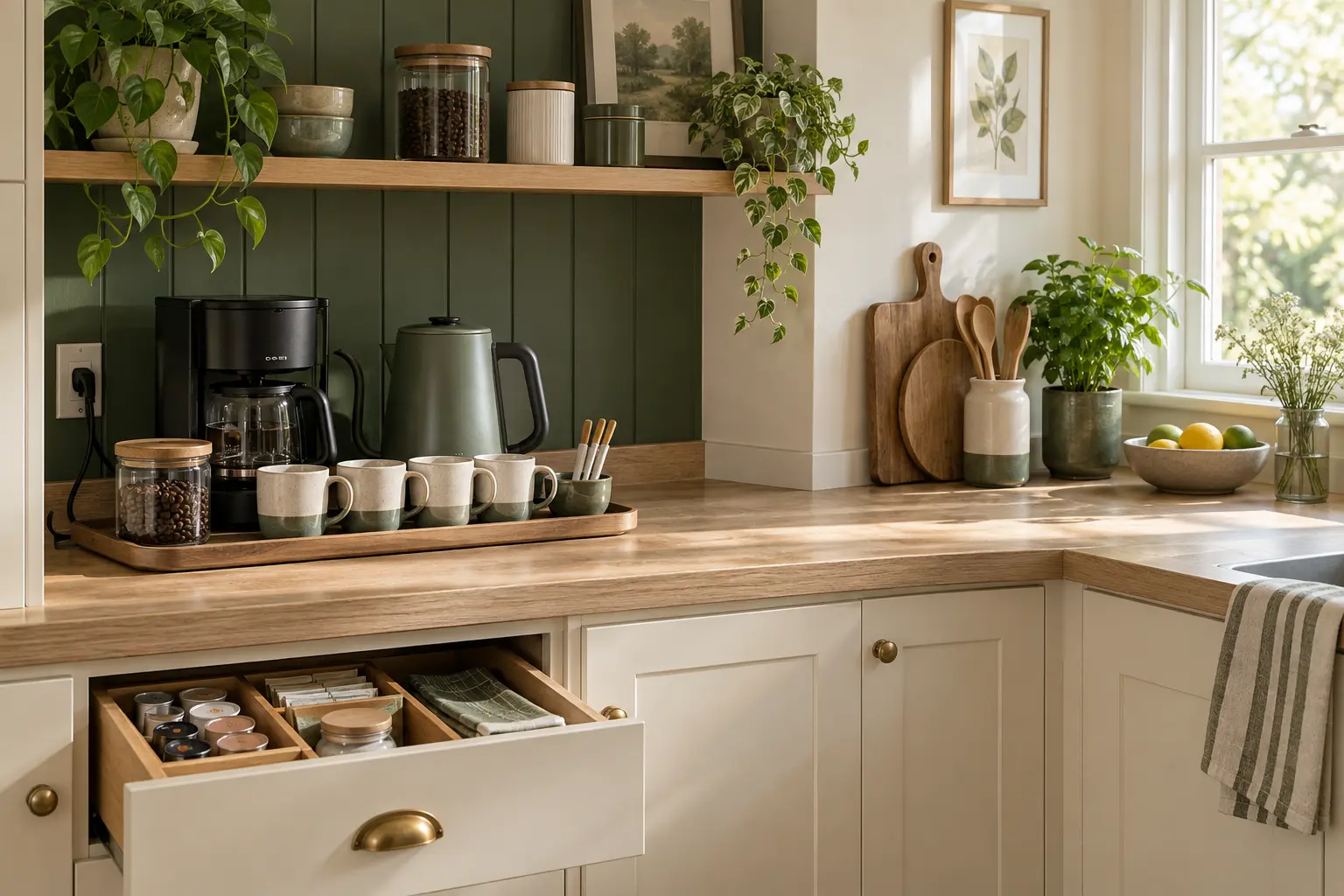
A washable tray can define the station and catch ordinary dry crumbs when it fits beneath the machine without blocking ventilation or access. It should be shallow enough to wipe around and easy to lift only when safely unloaded. Keep the appliance stable and follow its placement instructions.
Limit the tray to the machine and one or two daily supplies. When unrelated mail, snacks or cooking ingredients begin to gather there, return them to their working zones rather than choosing a larger tray.
4. Keep a practical number of mugs nearby
Store the mugs used between normal washing cycles near the station, in a cabinet, shallow drawer or suitable shelf. Keep the remainder with serving ware or edit the collection if it exceeds available storage. Do not install hooks or shelves without checking the wall, lease, hardware and rated load.
Open mug storage requires more dusting and visual maintenance. Closed storage may be calmer even when it adds one step to the routine. Choose the trade-off the household will maintain.
5. Store small supplies in one drawer or bin
Group filters, pods, tea bags, measuring tools or stirrers in one nearby drawer section or shallow bin. Keep food labels, dates and preparation information when relevant. Avoid storing supplies where steam, splashes or heat could affect them, and follow any product-specific storage guidance.
Keep backstock in the small-pantry system rather than expanding the counter station. Refill only the quantity that fits the daily zone comfortably.
6. Plan the water, waste and cleaning path
The station should be convenient to fill and clean without requiring a full reservoir or hot appliance to cross a crowded room. Follow the equipment directions for emptying grounds, pods, trays and water. Keep a small cloth nearby only if it can dry properly and does not become a permanent damp item on the counter.
Wipe spills promptly using the surface and appliance care instructions. Do not let a decorative mat hide moisture, crumbs or cord damage.
7. Use a cabinet or cart when the counter is too small
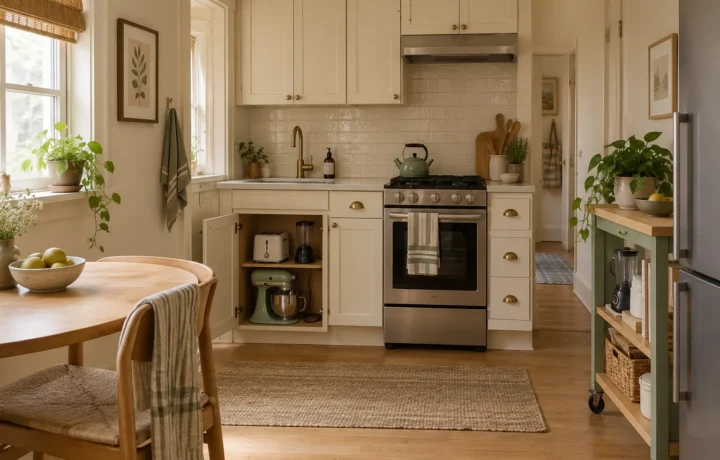
A nearby cabinet can hold supplies while the appliance moves to the counter for use. A stable cart can create a separate zone when it has a safe parking place and suitable load capacity. Neither location is automatically safe for operating equipment; use a machine there only when the surface, ventilation, water and electrical setup meet its instructions.
For rentals, prefer a freestanding solution unless the lease and property owner allow installation. Our renter-friendly kitchen guide explains how to evaluate removable and portable changes.
8. Reset the station after the final drink
Return supplies, empty or clean components as directed, wipe the work area and leave the machine in its required condition. Restock only enough for the next routine. A short closing reset prevents the station from slowly becoming general counter storage.
- Follow the machine’s cleaning steps
- Return filters and tools
- Move dirty mugs to the washing area
- Wipe the tray and counter
- Keep the adjacent prep zone clear
Frequently asked questions
How do I make a coffee station in a small kitchen?
Define one daily beverage routine, measure the appliance at full use, protect the main prep area and keep only the active supplies on a shallow tray or in nearby storage.
What should go on a small coffee station?
Keep the machine or kettle, the daily coffee or tea, one measuring tool and a practical number of mugs nearby. Store occasional supplies and backstock elsewhere.
Can a coffee station go on a cart?
A cart can provide storage when it is stable, correctly loaded and parked out of circulation. Operate equipment there only when the cart and appliance requirements make the setup safe.
How do I keep a coffee station from getting cluttered?
Give the station a fixed footprint, move backstock to pantry storage and reset the tray after the final drink. Do not let unrelated categories remain in the zone.